
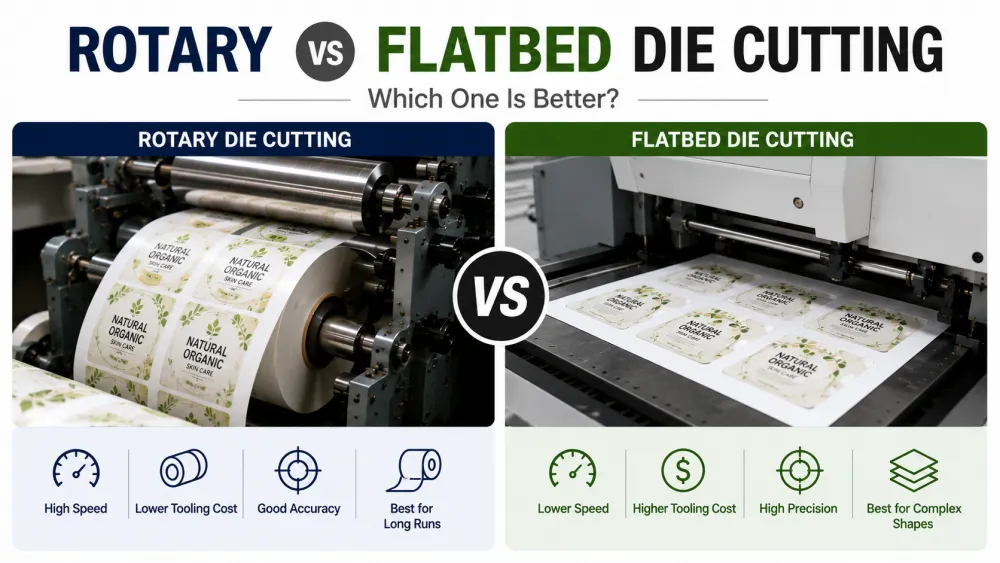
Rotary vs Flatbed Die Cutting: Why the Choice Matters
Die cutting is one of the most important stages in label manufacturing. After printing, labels must be cut into their final shape while remaining attached to the release liner for application.
When planning a label production line, buyers often face a common question:
Should I choose a rotary die cutting machine or a flatbed die cutting machine?
Both technologies are widely used in the label industry, but they are designed for different production requirements, order volumes, materials, and investment strategies.
Understanding the differences can help buyers avoid costly mistakes and choose equipment that better matches their business goals.
What Is Rotary Die Cutting?
Rotary die cutting uses a cylindrical rotary die that continuously cuts label material as it moves through the machine.
The die rotates together with the material web, allowing continuous production at high speed.
Rotary die cutting is commonly integrated into:
- Flexographic label printing machines
- Semi-rotary label presses
- Inline label converting lines
- High-volume label production systems
Because the process is continuous, rotary die cutting is widely used for large production runs where efficiency and speed are critical.
What Is Flatbed Die Cutting?
Flatbed die cutting uses a flat steel rule die that presses vertically against the label material.
Instead of rotating continuously, the die moves up and down to perform individual cutting actions.
Flatbed systems are commonly used for:
- Short production runs
- Special label shapes
- Thicker materials
- Prototype production
- Frequent design changes
Because tooling costs are generally lower, flatbed die cutting is often attractive for companies producing many different label designs in smaller quantities.
Rotary vs Flatbed Die Cutting: Key Differences
| Factor | Rotary Die Cutting | Flatbed Die Cutting |
| Production Speed | Very High | Moderate |
| Tooling Cost | Higher | Lower |
| Setup Time | Longer | Shorter |
| Large Volume Orders | Excellent | Limited |
| Short Run Production | Acceptable | Excellent |
| Complex Shapes | Good | Excellent |
| Material Thickness | Moderate | Better for Thick Materials |
| Cost Per Label | Lower for Large Volumes | Higher for Large Volumes |
Production Speed Comparison
Speed is often the first factor buyers evaluate.
Rotary die cutting is significantly faster because the cutting process is continuous.
For large label manufacturers processing millions of labels each month, rotary systems provide major productivity advantages.
Flatbed machines typically operate at lower speeds because each cutting cycle requires a separate press action.
For small and medium-sized production runs, however, the speed difference may not justify the higher investment associated with rotary tooling.
Tooling Cost Comparison
Tooling cost is one of the biggest differences between the two technologies.
Rotary dies are precision-machined cylinders and generally cost more to manufacture.
Flatbed dies use steel rule construction and are usually less expensive.
Companies producing many different label designs may find flatbed tooling more economical because new dies can be produced quickly and at lower cost.
Which Technology Handles Complex Label Shapes Better?
Both technologies can produce high-quality labels, but flatbed die cutting often offers greater flexibility for highly complex designs.
Labels with unusual contours, intricate patterns, or specialty packaging requirements are commonly produced using flatbed systems.
For standard label shapes such as rectangles, circles, and common packaging labels, rotary die cutting typically provides more than enough precision.
Material Compatibility
Label manufacturers process a wide variety of materials, including:
- Self-adhesive paper
- BOPP film
- PET film
- PE film
- Thermal label stock
- Vinyl materials
- Laminated constructions
Rotary die cutting performs exceptionally well with most standard label materials used in large-scale production.
Flatbed die cutting often provides additional advantages when processing thicker or specialty materials that require greater cutting force.
When Should You Choose Rotary Die Cutting?
Rotary die cutting is generally the better choice when:
- You produce high label volumes.
- You run long production jobs.
- You need maximum production efficiency.
- You want lower cost per label at scale.
- You operate a flexographic label production line.
Large label manufacturers serving food, beverage, logistics, and consumer goods markets often prefer rotary systems because of their speed and efficiency.
When Should You Choose Flatbed Die Cutting?
Flatbed die cutting is often the better option when:
- You produce many different label designs.
- You run short production jobs.
- You require lower tooling investment.
- You process specialty materials.
- You frequently change label specifications.
Companies focused on custom labels, boutique packaging, promotional products, or prototype development often benefit from flatbed technology.
Which System Is Better for New Label Businesses?
For new investors entering label manufacturing, the answer depends on the target market.
If production will focus on high-volume standard labels, rotary die cutting usually offers stronger long-term efficiency.
If customers require many different label designs in smaller quantities, flatbed die cutting may provide greater flexibility and lower startup costs.
The most important consideration is not which technology is better overall, but which technology better matches your customers, order structure, and future growth plans.
Equipment Planning Beyond Die Cutting
Die cutting is only one part of the label manufacturing process.
Many production lines also include:
When evaluating equipment investments, buyers should consider the complete workflow rather than selecting individual machines independently.
Conclusion
Neither rotary nor flatbed die cutting is universally better. Each technology offers advantages depending on production volume, label design complexity, material type, and business objectives.
Rotary die cutting is typically preferred for high-speed, high-volume label production, while flatbed die cutting offers greater flexibility and lower tooling costs for short runs and specialty applications.
By understanding the strengths of each approach, label manufacturers, distributors, and investors can make more informed equipment decisions and build production lines that support long-term business growth.


