Daily and Preventive Maintenance Checklist
Consistent maintenance is one of the most effective ways to maximize the performance, reliability, and service life of a paper cup machine. While modern equipment is designed for continuous production, neglecting routine inspection and preventive maintenance can lead to unexpected downtime, reduced production efficiency, and higher operating costs.
A structured maintenance program does more than prevent equipment failures—it helps maintain product quality, improves operator safety, reduces spare parts consumption, and protects your investment over the long term.
Whether you operate a single paper cup machine or manage a complete production line, establishing clear maintenance procedures allows your factory to maintain stable production while minimizing costly interruptions.
Why Preventive Maintenance Matters
Many production problems develop gradually rather than appearing suddenly. Components such as bearings, chains, heating systems, sensors, and pneumatic parts naturally wear over time. Without regular inspection, these small issues may eventually result in machine stoppages or product defects.
Preventive maintenance focuses on identifying potential problems before they affect production. Instead of repairing equipment after a breakdown, operators perform scheduled inspections, lubrication, adjustments, and component replacement based on operating conditions.
| Reactive Maintenance | Preventive Maintenance |
|---|---|
| Repair after failure occurs | Prevent problems before failure |
| Unexpected downtime | Scheduled maintenance |
| Higher repair costs | Lower long-term maintenance costs |
| Production interruptions | Stable production efficiency |
| Shorter component life | Extended equipment lifespan |
For manufacturers operating continuous production schedules, preventive maintenance is not simply a maintenance activity—it is an important part of production management.
Recommended Maintenance Schedule
Different machine components require inspection at different intervals. Organizing maintenance tasks by frequency makes them easier to manage and helps reduce the risk of overlooking critical items.
| Maintenance Interval | Main Tasks |
|---|---|
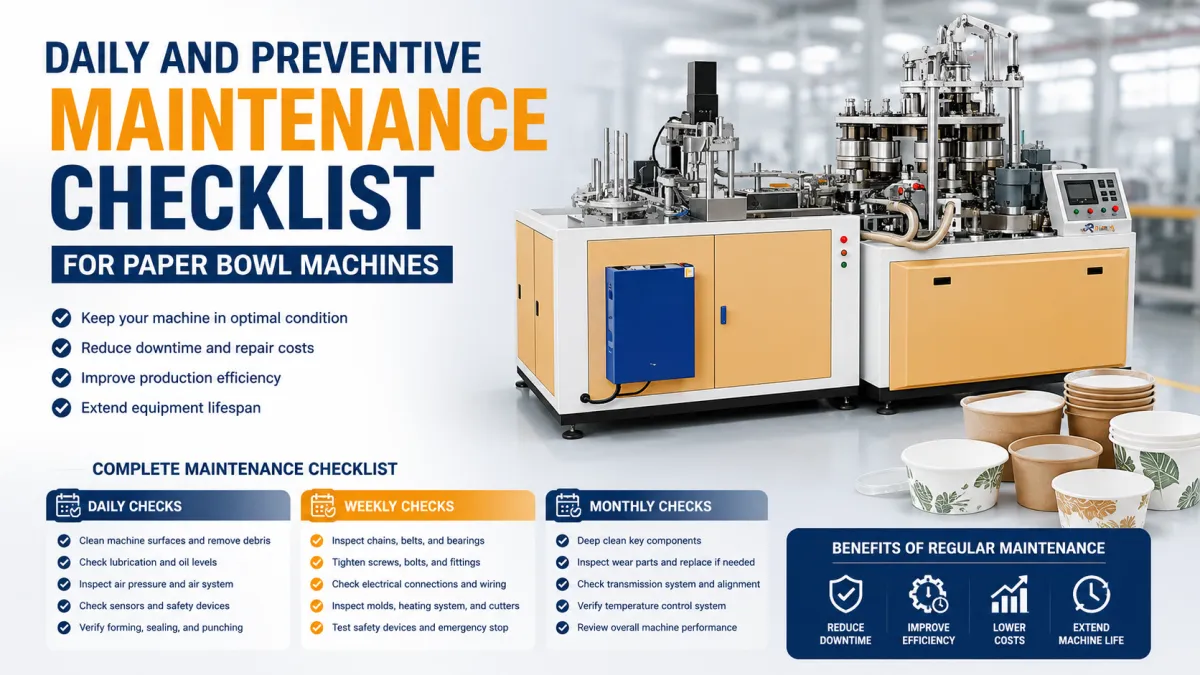
| Daily | Cleaning, lubrication check, air pressure, heating temperature, sensor inspection |
| Weekly | Chain inspection, fastener tightening, transmission system check, pneumatic inspection |
| Monthly | Electrical cabinet inspection, bearing condition, heating system calibration, mold inspection |
| Quarterly | Comprehensive mechanical inspection, drive system adjustment, safety system verification |
| Annually | Major preventive maintenance, replacement of worn components, complete machine inspection |
Following a standardized maintenance schedule allows operators to perform inspections systematically while minimizing disruption to normal production.
Daily Maintenance Checklist
Daily inspections require only a short amount of time but play a significant role in maintaining production stability. These checks should be completed before production starts and again at the end of each shift.
| Inspection Item | Daily Check |
|---|---|
| Machine cleanliness | ✔ Remove paper dust and production waste |
| Lubrication points | ✔ Verify proper lubrication |
| Heating system | ✔ Confirm operating temperature |
| Compressed air pressure | ✔ Verify stable pressure |
| Paper feeding system | ✔ Check alignment and feeding stability |
| Sensors | ✔ Ensure proper detection |
| Cup forming quality | ✔ Inspect finished cup appearance and sealing |
| Abnormal vibration or noise | ✔ Investigate immediately if detected |
Small abnormalities discovered during daily inspection are usually much easier and less expensive to correct than major equipment failures.
Weekly Maintenance Checklist
Weekly maintenance focuses on mechanical systems that experience continuous movement during production. These inspections help maintain smooth machine operation and reduce long-term wear.
- Inspect drive chains and sprockets for wear.
- Check belt tension and transmission components.
- Tighten accessible bolts and mechanical fasteners.
- Clean paper dust from electrical cabinets and ventilation openings.
- Inspect pneumatic hoses and fittings for leakage.
- Verify mold alignment and fastening condition.
- Check safety guards and emergency stop functions.
If production operates continuously over multiple shifts, some weekly inspections may be performed more frequently depending on machine workload.
When selecting equipment designed for reliable long-term operation, explore our Paper Cup Machines to compare different production capacities and machine configurations for various manufacturing requirements.
Monthly and Annual Preventive Maintenance
While daily and weekly inspections help maintain stable production, monthly and annual preventive maintenance focuses on the long-term reliability of the entire machine. These scheduled inspections allow maintenance personnel to identify wear, verify system performance, and replace components before unexpected failures occur.
Planned maintenance during scheduled production breaks is generally more cost-effective than repairing equipment after an unexpected shutdown.
| Maintenance Interval | Recommended Tasks |
|---|---|
| Monthly | Inspect bearings, calibrate heating systems, verify electrical connections, check mold wear, inspect drive chains and lubrication condition. |
| Quarterly | Inspect pneumatic valves, servo systems (if equipped), transmission assemblies, safety switches, and control cabinet cooling systems. |
| Annually | Perform comprehensive machine inspection, replace worn consumable components, inspect electrical wiring, update lubrication, and verify overall machine accuracy. |
A preventive maintenance schedule should always be adjusted according to production hours, operating environment, and the types of paper products being manufactured.
Critical Components That Require Regular Inspection
Not every machine component experiences the same level of wear. Focusing maintenance resources on high-wear and high-impact components helps reduce unexpected downtime while maintaining consistent production quality.
| Component | Inspection Focus | Typical Purpose |
|---|---|---|
| Heating System | Temperature stability and heating efficiency | Maintain reliable cup sealing |
| Bearings | Noise, lubrication, operating temperature | Reduce mechanical wear |
| Drive Chains & Sprockets | Tension and wear condition | Maintain synchronized machine movement |
| Pneumatic Components | Air leakage and pressure stability | Ensure smooth feeding and forming |
| Sensors | Cleaning and positioning accuracy | Prevent production interruptions |
| Molds | Wear, alignment, fastening | Maintain cup dimensional accuracy |
| Electrical Cabinet | Dust removal and wiring inspection | Improve electrical reliability |
Regular inspection of these key components helps maintain production consistency while reducing emergency repairs.
Recommended Spare Parts Inventory
Maintaining a small inventory of essential spare parts allows factories to respond quickly when replacement is required, minimizing production interruptions caused by waiting for international shipments.
| Recommended Spare Part | Purpose |
|---|---|
| Heating Elements | Replace worn or damaged heating units |
| Sensors | Restore detection accuracy |
| Bearings | Replace components showing excessive wear |
| Drive Chains | Maintain stable transmission performance |
| Pneumatic Seals & Fittings | Repair air leakage |
| Belts | Replace worn transmission belts |
| Fuses & Electrical Components | Support electrical troubleshooting |
| Lubricants | Routine preventive maintenance |
Keeping these frequently used components in stock can significantly reduce machine downtime and improve overall production continuity.
Maintenance Record Template
Recording maintenance activities helps operators monitor equipment condition over time, identify recurring issues, and plan future maintenance more effectively.
| Date | Machine Area | Maintenance Performed | Operator | Remarks |
|---|---|---|---|---|
| __________ | ________________ | ________________________ | __________ | ________________ |
| __________ | ________________ | ________________________ | __________ | ________________ |
| __________ | ________________ | ________________________ | __________ | ________________ |
Well-maintained service records make it easier to schedule preventive maintenance, analyze machine performance, and support long-term production planning.
Common Maintenance Mistakes to Avoid
Many maintenance problems are caused not by equipment design but by inconsistent maintenance practices. Avoiding the following common mistakes helps improve machine reliability and extend service life.
- Ignoring small abnormalities such as unusual vibration or noise.
- Applying excessive or insufficient lubrication.
- Operating the machine without cleaning accumulated paper dust.
- Delaying replacement of worn components until failure occurs.
- Skipping scheduled inspections during busy production periods.
- Using non-recommended replacement parts without verifying compatibility.
- Failing to document completed maintenance activities.
A disciplined preventive maintenance program is far more effective than reacting only after production has already been interrupted.
Before establishing a maintenance routine, it is also important to ensure the machine has been installed and commissioned correctly. Our Machine Installation and Production Startup Guide explains how proper installation and operator training provide the foundation for reliable long-term machine performance.
Signs Your Machine Needs Professional Service
Even with a well-planned preventive maintenance program, machines may occasionally require professional technical support. Recognizing early warning signs allows maintenance teams to address issues before they develop into major production interruptions.
| Warning Sign | Possible Cause | Recommended Action |
|---|---|---|
| Unusual vibration | Loose components, worn bearings, or transmission issues | Stop the machine and inspect the drive system |
| Abnormal operating noise | Insufficient lubrication or mechanical wear | Inspect lubrication points and moving parts |
| Inconsistent cup quality | Mold wear, heating instability, or parameter deviation | Inspect forming system and recalibrate machine settings |
| Frequent machine alarms | Sensor contamination or electrical faults | Check sensors, wiring, and control systems |
| Air pressure fluctuations | Pneumatic leakage or compressor issues | Inspect hoses, valves, and air supply |
| Increasing reject rate | Component wear or incorrect operating parameters | Perform a complete preventive maintenance inspection |
Responding to these warning signs promptly helps maintain production efficiency and reduces the likelihood of unexpected equipment failures.
How Preventive Maintenance Reduces Operating Costs
Some manufacturers view maintenance as an operating expense. In reality, preventive maintenance is an investment that protects production capacity and lowers the total cost of ownership over the machine's lifetime.
| Without Preventive Maintenance | With Preventive Maintenance |
|---|---|
| Unexpected production downtime | Planned maintenance during scheduled breaks |
| Higher emergency repair costs | Lower maintenance expenses through early intervention |
| Greater material waste | More consistent product quality |
| Shorter component lifespan | Extended service life of critical parts |
| Reduced production efficiency | Stable machine performance and higher equipment utilization |
For factories operating multiple shifts or high-volume production, even a small reduction in unplanned downtime can result in significant savings over the course of a year.
Building a Long-Term Maintenance Culture
The most successful paper cup manufacturers treat maintenance as part of daily production management rather than an occasional repair task. Clear maintenance responsibilities, regular inspections, and accurate service records help create a culture of continuous improvement throughout the factory.
A complete maintenance program should include:
- Standardized inspection procedures for every production shift.
- Clearly assigned maintenance responsibilities.
- Routine replacement of high-wear components before failure.
- Accurate maintenance records for future reference.
- Regular operator training and safety awareness.
- Periodic review of machine performance and maintenance schedules.
Factories that combine disciplined maintenance practices with well-trained operators are generally able to achieve higher production efficiency, lower operating costs, and more consistent product quality over the long term.
Frequently Asked Questions
How often should a paper cup machine be inspected?
Basic inspections should be performed before every production shift, while weekly, monthly, and annual preventive maintenance should follow a planned schedule based on operating hours and production intensity.
What is the difference between daily maintenance and preventive maintenance?
Daily maintenance focuses on routine cleaning and inspection before and after production, while preventive maintenance includes scheduled servicing, calibration, lubrication, and replacement of worn components to prevent unexpected failures.
Which machine components wear out most frequently?
High-wear components typically include heating elements, bearings, drive chains, pneumatic seals, sensors, and certain mold components, depending on production volume and operating conditions.
Should spare parts be kept in stock?
Yes. Keeping commonly used spare parts on-site allows factories to replace worn components quickly and minimizes production delays caused by waiting for replacement parts.
Can preventive maintenance improve production quality?
Yes. Proper maintenance helps maintain stable machine performance, improves cup consistency, reduces reject rates, and supports continuous high-quality production.
How can operators identify potential problems early?
Operators should pay attention to unusual vibration, abnormal noise, inconsistent cup quality, unexpected alarms, and changes in machine performance during daily production.
Does preventive maintenance reduce operating costs?
In most factories, preventive maintenance reduces emergency repairs, minimizes downtime, extends equipment life, and lowers the total cost of ownership over the machine's operating life.
Can maintenance schedules be adjusted?
Yes. Maintenance intervals should be adapted according to production hours, paper materials, machine configuration, and the operating environment rather than following a fixed schedule alone.
Maintain Today, Produce Better Tomorrow
Consistent maintenance is one of the simplest and most effective ways to protect your paper cup production investment. By combining daily inspections with a structured preventive maintenance program, manufacturers can improve equipment reliability, extend machine life, reduce operating costs, and maintain stable product quality.
Whether you operate a single machine or a complete paper cup production line, investing time in maintenance today helps avoid costly downtime and supports sustainable production growth in the future.
If you are planning to upgrade your production capacity or invest in new equipment, the RD-XLF200BF Servo Paper Cup Machine combines high-speed automation with reliable mechanical design, making routine maintenance more efficient while supporting stable, long-term commercial production.