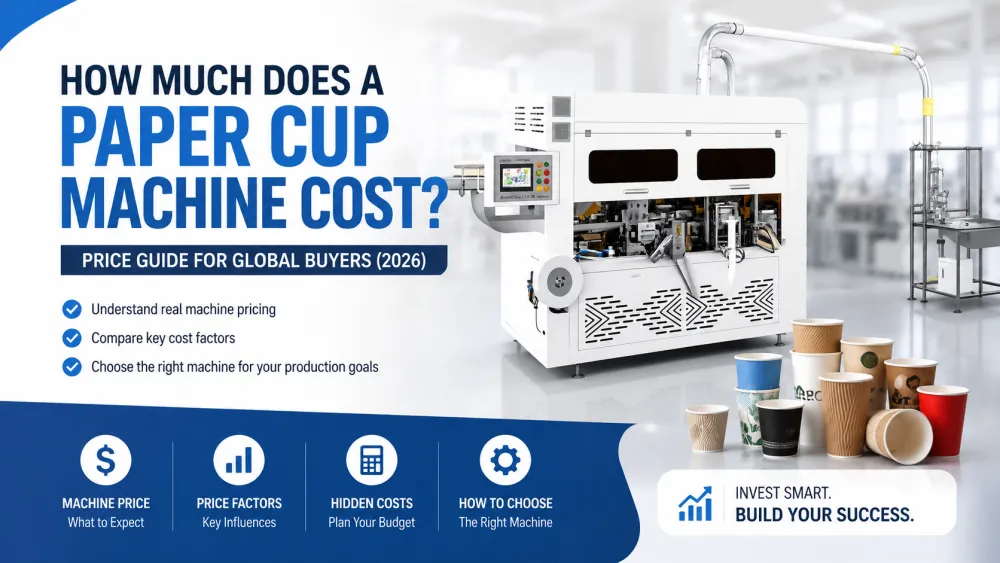
How Much Does a Paper Cup Machine Cost?
One of the first questions buyers ask when planning a paper cup production project is: "How much does a paper cup machine cost?" Unfortunately, there is no universal answer. Prices can range from less than USD 15,000 for entry-level models to well over USD 150,000 for fully automatic high-speed production systems.
The large price difference often confuses first-time buyers, trading companies, and distributors. Many assume that every paper cup machine performs the same function, yet machines with similar appearances can differ significantly in production speed, automation level, forming quality, service life, and operating costs.
Instead of asking "What is the cheapest paper cup machine?", experienced manufacturers ask a different question:
Which machine offers the best long-term return on investment for my production requirements?
This guide explains what influences paper cup machine pricing, typical investment ranges, hidden project costs, and how to select equipment that matches your production goals instead of paying for unnecessary features.
Typical Paper Cup Machine Price by Machine Type
The following table provides typical investment ranges for different categories of paper cup machines. Actual quotations vary depending on configuration, automation level, production speed, mold requirements, and optional equipment.
| Machine Type | Typical Speed | Typical Price Range (USD) | Suitable For |
|---|---|---|---|
| Semi-Automatic Paper Cup Machine | 35–60 cups/min | $8,000–15,000 | Small workshops and startups |
| Standard Automatic Paper Cup Machine | 60–100 cups/min | $15,000–30,000 | Growing packaging companies |
| High-Speed Paper Cup Machine | 100–160 cups/min | $30,000–60,000 | Commercial paper cup manufacturers |
| Servo Paper Cup Machine | 160–260 cups/min | $60,000–150,000+ | Large-scale industrial production |
These ranges should be viewed as investment references rather than fixed selling prices. The same production speed may have very different prices depending on the supplier's engineering standards, component quality, and optional automation systems.
Why Do Paper Cup Machine Prices Vary So Much?
Many buyers receive quotations from multiple suppliers and discover surprisingly large price differences. One supplier may offer a machine for USD 20,000 while another quotes USD 70,000 or more.
In most cases, these differences are not caused by profit margins alone—they reflect substantial differences in machine design, manufacturing quality, production efficiency, and long-term operating costs.
The most common factors affecting machine pricing include:
1. Production Speed
Higher-speed machines require more advanced mechanical structures, servo systems, precision components, and stronger frame construction. A machine producing 200 cups per minute must maintain forming accuracy under much greater mechanical stress than a machine operating at 70 cups per minute.
2. Automation Level
Modern paper cup machines may include automatic paper feeding, cup collection, counting, lubrication, fault diagnosis, remote monitoring, and intelligent control systems. These features reduce labor costs and improve production stability, but they also increase the initial investment.
3. Component Quality
Bearings, motors, PLC controllers, servo drives, pneumatic components, electrical systems, and heating units all influence machine performance and lifespan. Premium components generally improve reliability while reducing maintenance requirements over many years of operation.
4. Machine Structure
Frame rigidity, machining accuracy, transmission design, and mold precision directly affect vibration levels, forming consistency, and machine durability. Well-engineered machines typically achieve higher production efficiency with fewer rejected cups.
5. Technical Support
The machine price often includes much more than equipment alone. Professional suppliers provide installation guidance, operator training, technical documentation, spare parts support, software updates, and long-term after-sales service.
When comparing quotations, buyers should evaluate the total value offered rather than focusing only on the purchase price.
Recommended Machine Based on Daily Production
One of the biggest mistakes new buyers make is selecting a machine based solely on budget. The correct approach is to determine your required daily output first and then choose equipment capable of meeting that production target efficiently.
| Target Daily Output | Recommended Machine Type | Typical Buyer |
|---|---|---|
| 20,000–40,000 cups | Standard Automatic Machine | Small factory or startup |
| 50,000–100,000 cups | High-Speed Machine | Packaging manufacturer |
| 100,000–200,000 cups | High-Speed Servo Machine | Commercial paper cup factory |
| 200,000+ cups | Multiple Servo Production Lines | Large industrial producer |
If you are still unsure which model matches your production requirements, you can explore our complete range of Paper Cup Machines to compare different production capacities and machine configurations.
What's Included in a Paper Cup Machine Quotation?
One of the biggest misunderstandings among first-time buyers is assuming that every quotation includes the same equipment and services. In reality, two suppliers may quote similar machine prices while offering completely different scopes of supply.
Before comparing quotations, always confirm exactly what is included. A lower initial price may exclude essential components or after-sales services that will increase your total investment later.
| Item | Usually Included | May Be Optional |
|---|---|---|
| Paper Cup Forming Machine | ✓ | - |
| One Standard Mold Set | ✓ | Additional molds |
| Machine Commissioning | Depends on supplier | ✓ |
| Operator Training | Depends on supplier | ✓ |
| Spare Parts Kit | Usually basic | Extended package |
| Remote Technical Support | Usually included | - |
| Installation Service | Optional | ✓ |
| Shipping & Insurance | Depends on Incoterms | ✓ |
Always request a detailed quotation that clearly lists machine specifications, accessories, optional equipment, warranty coverage, and after-sales support. This makes supplier comparisons much more meaningful than comparing prices alone.
Hidden Costs Many Buyers Forget
The machine itself is only one part of a paper cup production project. Many new investors underestimate the additional costs required to put a production line into operation.
Before making a purchasing decision, consider the following expenses:
| Investment Item | Why It Matters |
|---|---|
| Shipping & Customs | Varies by destination country and shipping method |
| Installation & Commissioning | Ensures the machine is correctly installed and tested |
| Air Compressor | Required for pneumatic systems |
| Additional Mold Sets | Needed for producing multiple cup sizes |
| Electrical Installation | Power supply and factory preparation |
| Raw Materials | PE-coated paper, bottom rolls, packaging materials |
| Operator Training | Improves production efficiency and reduces waste |
| Initial Spare Parts Inventory | Reduces downtime during production |
Planning these costs before purchasing helps avoid unexpected expenses after the machine arrives at your factory.
Why the Cheapest Machine Isn't Always the Lowest-Cost Investment
Many buyers naturally compare quotations by purchase price. However, experienced manufacturers focus on the total cost of ownership rather than the initial investment.
For example, a lower-priced machine may:
- Require more operators
- Consume more spare parts
- Produce a higher reject rate
- Require more maintenance
- Operate at lower actual production speeds
- Experience longer production downtime
By comparison, a higher-quality machine often delivers better productivity, greater stability, and lower operating costs throughout its service life.
When evaluating quotations, calculate how much each machine can produce over five to ten years instead of comparing only the purchase price.
How Trading Companies Can Quote Customers More Professionally
Many trading companies receive customer inquiries without fully understanding the technical requirements behind them. A customer may simply ask for "a paper cup machine," but that information alone is not enough to prepare an accurate quotation.
Before requesting pricing from a manufacturer, traders should gather the following information:
- Finished cup size (4oz, 8oz, 12oz, 16oz, etc.)
- Hot drink or cold drink application
- Single PE, double PE, or PLA-coated paper
- Target daily production capacity
- Required automation level
- Available factory power supply
- Destination country
- Future expansion plans
Providing complete project information allows manufacturers to recommend the most suitable machine configuration instead of sending a generic quotation that may not match the customer's actual production needs.
Questions Every Buyer Should Ask Before Requesting a Quote
Requesting multiple quotations is only useful if you ask every supplier the same technical questions. This makes it much easier to compare machine performance, service, and long-term value.
- What is the stable production speed under normal operating conditions?
- What cup sizes can be produced with this machine?
- How many mold sets are included?
- Can the machine process both single PE and double PE paper?
- What electrical components and PLC brands are used?
- What warranty is provided?
- Is installation support available?
- How quickly can spare parts be supplied?
- Can the machine be tested with my paper before shipment?
- What after-sales support is available after installation?
These questions often reveal far more about a supplier's capabilities than the quotation itself.
Calculate Return on Investment Instead of Comparing Purchase Price
A paper cup machine should be viewed as a long-term production asset rather than a one-time expense. The most profitable machine is not necessarily the least expensive—it is the one that delivers the lowest production cost per cup while maintaining stable quality and high operating efficiency.
When calculating return on investment (ROI), consider factors such as production capacity, labor savings, material utilization, maintenance costs, and expected service life.
For a more detailed breakdown of raw materials, operating expenses, and production cost per cup, you can also read our guide: Paper Cup Manufacturing Cost Analysis.
How Ruida Helps Buyers Choose the Right Paper Cup Machine
At Zhejiang Ruida Machinery, we understand that every paper cup production project is different. Two factories may produce the same 12oz paper cup but require completely different machine configurations depending on production volume, labor costs, available factory space, and future expansion plans.
Rather than recommending the most expensive machine, our engineering team focuses on helping customers select equipment that matches their production goals while maximizing long-term profitability.
When evaluating your project, we typically consider:
- Finished cup sizes and product range
- Daily and annual production targets
- Hot drink, cold drink, or food container applications
- Paper specifications and coating type
- Available factory utilities and installation conditions
- Expected level of automation
- Budget and return-on-investment objectives
- Future production expansion plans
This project-based approach allows buyers to invest in equipment that supports both current production requirements and long-term business growth.
How to Request an Accurate Paper Cup Machine Quotation
The more information you provide, the more accurate and useful your quotation will be. Instead of requesting only a machine price, prepare the following project details before contacting suppliers.
| Information to Provide | Why It Is Important |
|---|---|
| Cup Size | Determines mold design and machine configuration |
| Paper Specification | Influences heating system and forming process |
| Production Capacity | Helps determine the appropriate machine speed |
| Finished Products | Paper cups, bowls, containers, or multiple products |
| Voltage Standard | Ensures electrical compatibility |
| Destination Country | Determines shipping, certification, and service planning |
| Project Timeline | Supports production scheduling and delivery planning |
Providing these details allows suppliers to recommend a machine configuration that matches your production requirements instead of sending a generic quotation that may not reflect your actual needs.
Frequently Asked Questions
How much does an automatic paper cup machine cost?
Most automatic paper cup machines fall within a broad investment range depending on production speed, automation level, machine configuration, and optional features. Entry-level automatic models are significantly less expensive than high-speed servo-driven production systems.
Why do quotations from different suppliers vary so much?
Differences in machine design, production speed, component quality, automation, technical support, warranty coverage, and included accessories all influence the final quotation. Comparing only the purchase price may not accurately reflect the long-term value of the equipment.
Is a high-speed paper cup machine worth the investment?
For manufacturers with consistent production demand, higher-speed machines often reduce labor costs, improve productivity, and lower the cost per cup over time. The best choice depends on your production volume and business objectives.
Can one machine produce different cup sizes?
Yes. Most paper cup machines can manufacture multiple cup sizes by changing molds and making the necessary machine adjustments. Buyers planning to produce several cup sizes should discuss mold compatibility before purchasing.
Does the machine price include molds?
Many suppliers include one standard mold set with the machine, while additional molds for other cup sizes are usually quoted separately. Always confirm what is included in the quotation.
Can the machine process both single PE and double PE paper?
Many modern paper cup machines are designed to process both single PE-coated and double PE-coated paper, although the exact capability depends on the machine model and production requirements.
How long does installation usually take?
Installation time varies according to machine complexity, factory preparation, and operator experience. Most projects can begin trial production shortly after installation and commissioning are completed.
What information should I prepare before asking for a quotation?
Prepare details such as cup size, daily production target, paper specification, voltage, destination country, and any special production requirements. This enables suppliers to recommend the most suitable machine configuration.
How can I reduce my overall investment cost?
The best approach is to select equipment that matches your actual production requirements. Purchasing a machine that is too small may limit future growth, while purchasing one that is significantly larger than needed may increase unnecessary capital investment.
Is buying directly from a manufacturer better than buying through a trading company?
Both options can be suitable depending on the project. Purchasing directly from an experienced manufacturer may provide greater access to engineering support, machine customization, and long-term technical assistance, while trading companies may offer localized service and purchasing convenience in certain markets.
Final Thoughts
The cost of a paper cup machine should never be evaluated in isolation. Machine speed, automation level, production efficiency, component quality, technical support, and long-term operating costs all contribute to the real value of your investment.
For trading companies, distributors, and first-time investors, understanding these factors makes it much easier to compare suppliers, prepare accurate quotations for customers, and avoid costly purchasing mistakes.
Instead of searching for the lowest machine price, focus on selecting equipment that aligns with your production capacity, product range, and future business plans. A well-matched machine will deliver greater productivity, lower operating costs, and a faster return on investment over many years of operation.
If you are planning a new paper cup production project or expanding an existing factory, Zhejiang Ruida Machinery can help you evaluate your production requirements and recommend the most appropriate machine configuration based on your products, capacity goals, and long-term development plans.